
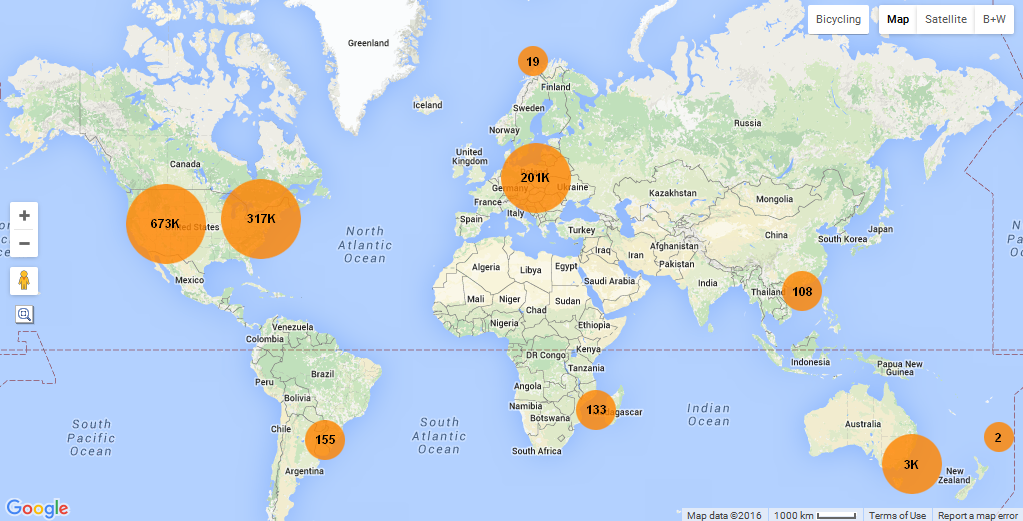
Falling Fruit is an interactive map meant to facilitate foraging public lands in urban environments all over the world.
Users contribute locations while the organizers of this program scan for pre-existing locations. The imported datasets range from small neighborhood foraging maps to vast professionally-compiled tree inventories. So far totaling to 1,255 different types of edibles distributed over 787,116 locations.
This map is open for anyone to edit, the database can be downloaded with just one click, and the code is open-source. Falling Fruit's sharing page lists hundreds of local organizations that you can be a part of. From planting public orchards and food forests, to picking otherwise-wasted fruits and vegetables from city trees and farmers' fields, and sharing with neighbors and the needy.
Users contribute locations while the organizers of this program scan for pre-existing locations. The imported datasets range from small neighborhood foraging maps to vast professionally-compiled tree inventories. So far totaling to 1,255 different types of edibles distributed over 787,116 locations.
This map is open for anyone to edit, the database can be downloaded with just one click, and the code is open-source. Falling Fruit's sharing page lists hundreds of local organizations that you can be a part of. From planting public orchards and food forests, to picking otherwise-wasted fruits and vegetables from city trees and farmers' fields, and sharing with neighbors and the needy.
Other Food Info
|
Local Harvest:
Find The Food Grown Near You (Turtle Island/North America) - Working With Soil: Encouraging Fertility Through Biodiversity

|
Laura founded Not Far From The Tree, an organization that harvests fruit bearing plants around the city of Toronto, taking the 100-kilometre diet to a new level. A third of the bounty goes to the volunteers, a third goes to the owner of the tree and a third goes to local shelters, preventing thousands of pounds of fruit from going to waste each year.
Guerrilla Grafters graft fruit bearing branches onto non-fruit bearing, ornamental trees. Over time, delicious, nutritious fruit is made available to urban residents through these grafts. Their aim is to prove that a culture of care can be cultivated from the ground up, to turn city streets into food forests, and unravel civilization one branch at a time.
Collaborative
Container Conservation Health and bulk foods stores can follow the Good Food Store's example of allow customers to drop their containers into a special bin and the store will sort and sterilize them, mark them with their packaging weight, and arrange them on a shelf for other shoppers to use. Creating a sense of collaborative conservation among the customers - all for the low cost of remembering to put your recycling into a bag. For customers, you can always go to other bulk food stores get the cashier to mark the packaging’s weight (“tare” weight) which would be discounted upon checkout. Incredible Edible
A small Victorian mill town of Todmorden in the UK grows food everywhere and aims for total food self-sufficiency by 2018. Watch the video below and follow the link to learn how they did it and how you can too. SEATTLE'S FOOD FOREST
Seattle’s vision of an urban food oasis is going forward. A seven-acre plot of land in the city’s Beacon Hill neighborhood will be planted with hundreds of different kinds of edibles: walnut and chestnut trees; blueberry and raspberry bushes; fruit trees, including apples and pears; exotics like pineapple, yuzu citrus, guava, persimmons, honeyberries, and lingonberries; herbs; and more. All will be available for public plucking to anyone who wanders into the city’s first food forest. 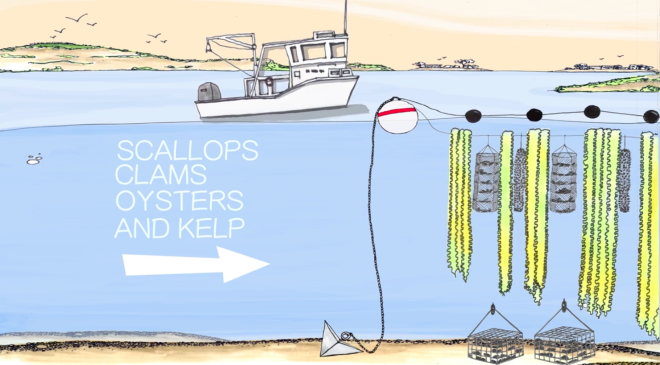
Vertical underwater farming
"a vertical underwater garden with hurricane-proof anchors on the edges connected by floating horizontal ropes across the surface. From these lines kelp and Gracilaria and other kinds of seaweeds grow vertically downward next to scallops in hanging nets that look like Japanese lanterns and mussels held in suspension in mesh socks. Staked below the vertical garden are oysters in cages and then clams buried in the sea floor." "The Boston Tree Party is an urban agriculture project, a performative re-imagining of American political expression, and a participatory public art project. At its core, the Party is a diverse coalition of organizations, institutions, and communities from across the Greater Boston Area coming together in support of Civic Fruit."
Farm To School Program
A program in the United States through which schools buy and feature locally produced, farm-fresh foods such as fruits and vegetables, eggs, honey, meat, and beans on their menus. Schools also incorporate nutrition-based curriculum and provide students with experiential learning opportunities such as farm visits, gardening, and recycling programs. As a result of Farm to School, students have access to fresh, local foods, and farmers have access to new markets through school sales. Farmers are also able to participate in programs designed to educate kids about local food and agriculture. 
The Edible
Schoolyard Project Started in 1995 by Alice Waters at Martin Luther King Jr. Middle School Berkeley, California with the idea to start a garden and then, build a teaching kitchen that could become tools for enriching the curriculum and life of the school community. Teaching fractions in the kitchen as a way of making math interactive, and growing heirloom grains in the garden as a way of teaching early civilizations. They hired a kitchen director with whom many of the school’s teachers collaborated to generate garden and kitchen lessons linked to classroom studies, scheduling regular class time with their students in the garden and kitchen. The Middle School was able to incorporate traditional school celebrations into the Edible Schoolyard Project, such as Family Writing Night and the English Language Learners Dinner. They have an annual Mother’s Day Plant Sale that has become a significant community and fundraising event. They've incorporated a summer program for students and host a teaching academy for educators from around the United States and the world, who want to begin or further develop, edible education programs in their communities. Each year, the Edible Schoolyard hosts over 1,000 visitors who experience its impact for themselves. Guests have included HRH Prince of Wales, Governor of California Jerry Brown, multiple state Senators, California’s Secretary of Agriculture and the Surgeon-General. For the 2005 Smithsonian Folklife Festival, they brought the Edible Schoolyard to the National Mall in Washington DC. The site was visited by one million people. The school has two 3,500-gallon cisterns that collect the rainwater that irrigates the lower orchard; a chicken coop for their expanding flock of chickens and ducks, using more than 500 eggs in the kitchen classroom; it is lush with more than one hundred varieties of seasonal vegetables, herbs, vines, berries, flowers and fruit trees. The Edible Schoolyard staff includes five teachers, two AmeriCorps members, and two adminstrative positions – fully supported by the project. A robust corps of thirty volunteers generously supports their work. They have served over 7,000 students, who often return to say that what they remember most about middle school is the time they spent in the Edible Schoolyard. 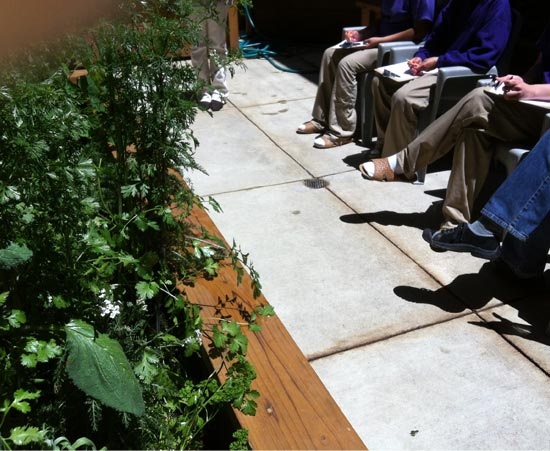
A Garden
Grows In Juvenile Hall The Juvenile Justice Center (JJC) in Twin Peaks neighborhood of San Francisco is growing a garden. Providing food, education and skills for the student's to leave with. Green Bronx Machine
A teacher growing green in the South Bronx. Creating a future of food, education, jobs, and community. “Black field, brown field, toxic waste field, battlefield — we're proving in the Bronx that you can grow anywhere.” “Kids should not have to leave their community to live, learn and earn in a better one.” The All Season Solar Cooker has a specialized design that allows cooking at any latitude whenever the sun is shining with minimal weight, cost, and adjustment. Simple, economical, lightweight. To build your own, free plans are available on the website under the "buy" tab.
Unconventional Community Gardening
Building
A Worm Composting Bin Hal Brindley and Leigh Ramsdell show you how and why to build your own worm composting bin. Created by Dodo Films.
Climate Change Adaptation Technology:
|
Do we really need industrial agriculture
to feed the world? Farming for the Future
Food is wasted
on a grand scale. How does this happen and how to fix it? Local Food Hub is an innovative hybrid nonprofit working to develop a sustainable local food distribution model in Charlottesville, Virginia. Connecting small local farmers with retailers.
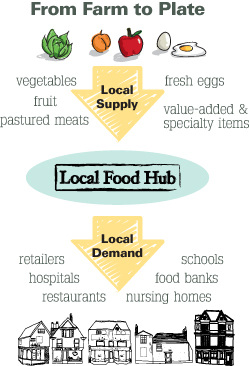
Image Source: Local Food Hub
BrightFarms A produce supply revolution; plant fruit and vegetable gardens on the roof of grocery stores to maximize freshness, minimize waste, reduce cost, and increase access to fresh food for those who need it
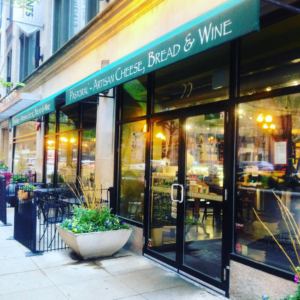
“Everybody who is in the collaborative is a small giant. We take care of our people, we take care of [those] we do business with, we take care of our community, and, in the process, take care of our resources.”
The Deraves family grows over 6,000 pounds of food per year, on 1/10 acre located just 15 minutes from downtown Los Angeles. This includes over 400 species of plants, 4,300 pounds of vegetable food, 900 chicken and 1,000 duck eggs, 25 lbs of honey, plus seasonal fruits throughout the year.
This family of four people gets over 90% of their daily food and earns $20,000 per year outside the savings from producing their own food. To follow the Dervaes and their Urban Homesteading activites, you can find them at http://urbanhomestead.org In the Canadian city of Calgary, Michelle and Rob Avis made themselves a cold climate food forest on their suburban lot. Watch this trailer to for a glimpse of what they've done, and follow this link to watch the full episode.
A Seed Library involves patrons checking out seeds for free, growing the fruits and vegetables, harvesting the new seeds, and "returning" those seeds so the library can lend them out to others. Watch this free webinar to learn how to start a Seed Library.
Seed Savers Exchange
A non-profit organization dedicated to saving and sharing heirloom seeds. Since 1975, their members have been passing on their garden heritage by collecting and distributing thousands of samples of rare garden seeds to other gardeners. 
Food Swap Network
A food swap is a recurring event where members of a community share homemade, homegrown, or foraged foods with each other. Swaps allow direct trades to take place between attendees on an item-by-item basis, e.g., a loaf of bread for a jar of pickles or a half-dozen backyard eggs. Swap events also include a potluck as an immediate food-sharing (and sometimes item-sampling) component. These events are a delicious way to diversify the homemade foods in your own pantry while getting to know members of your local food community. Introduction to Permaculture
Forest Gardening is a low-maintenance sustainable plant-based food production and agroforestry system based on woodland ecosystems, incorporating fruit and nut trees, shrubs, herbs, vines and perennial vegetables which have yields directly useful to humans. Making use of companion planting, these can be intermixed to grow in a succession of layers, to build a woodland habitat. (Forest Gardening, Wikipedia)
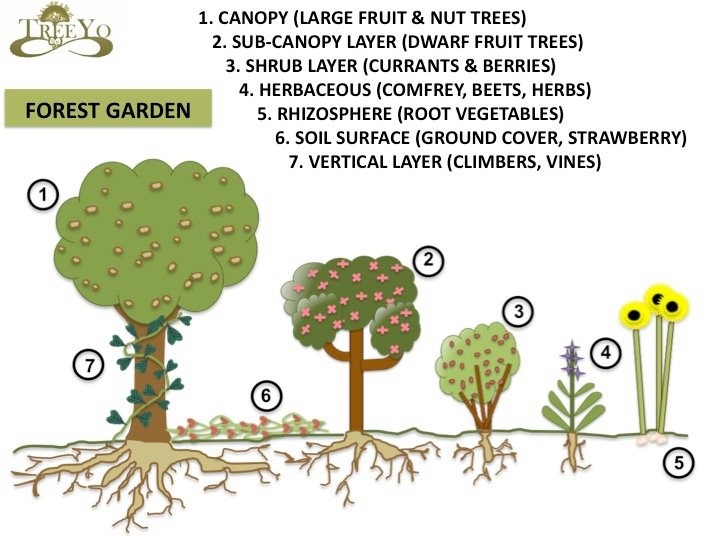
Layers of a Forest Garden
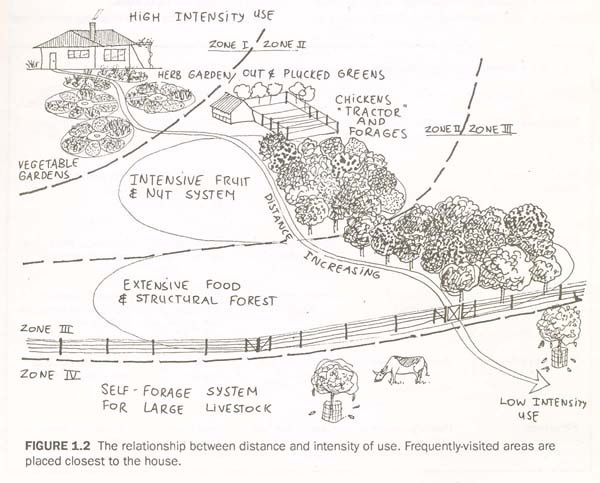
Permaculture Zones
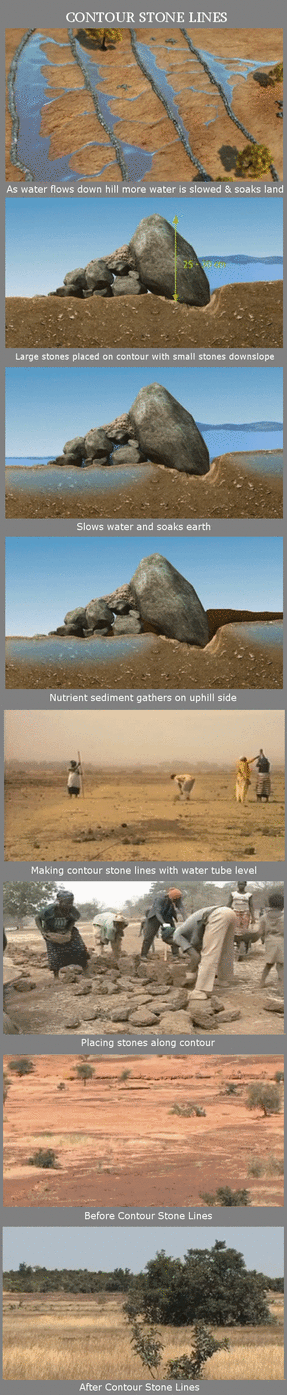
Greening Deserts
"It's possible to rehabilitate large-scale damaged ecosystems." Environmental film maker John D. Liu documents large-scale ecosystem restoration projects in China, Africa, South America and the Middle East, highlighting the enormous benefits for people and planet of undertaking these efforts globally.
More information: http://eempc.org/ What If We Change restoration media project: http://www.whatifwechange.org More information about permaculture designer Geoff Lawton's Greening the Desert project in Jordan: http://permaculturenews.org/2007/03/0... Permaculture Keyline
Water Systems: Don Tipping Seven Seeds Farm Permaculturalist Don Tipping takes us on a 10 minute tour of the Seven Seeds Farm in the Siskiyou Mountains of Southern Oregon, USA. The farm was designed using Permaculture Principles and Keyline patterning. Following the water system from top to bottom, revealing the downstream effects. This video was produced by Andrew Millison as part of the course content for his online Advanced Permaculture Design Practicum, Hort 485, taught through the Horticulture department at Oregon State University's Extended Campus: www.beaverstatepermaculture.com.
R&D-I-Y A web platform with 18,000+ global citizens
collaboratively innovating for environmental stewardship and quality of
urban life. The platform is currently being developed, building on their
alpha project, Windowfarms.
The Humanure Handbook
There are over seven billion defecating people on planet Earth, but few who have any clue about how to constructively handle the burgeoning mountain of human crap. "The Humanure Handbook," third edition, will amuse you, educate you, and possibly offend you, but it will certainly pertain to you--unless, of course, your bowels never move. This new edition of "The Humanure Handbook" is: The Tenth Anniversary Edition. Richly illustrated with eye-candy artwork. Perfect for reading while sitting on the "throne" Revised, improved, and updated 256 pages of crap
Follow this link on making your own fuel by harvesting methane from manure with a Biogas Digester instead of leaving this resource go unused on Geoff Lawton's Official website.
"It's about getting our shit together" | ||||||||||||